Why siding in Marietta turns green and black, and what a house wash does about it
The streaks on your siding are alive, which is why a garden hose never gets rid of them for long.
October 20, 2026 · 4 min read
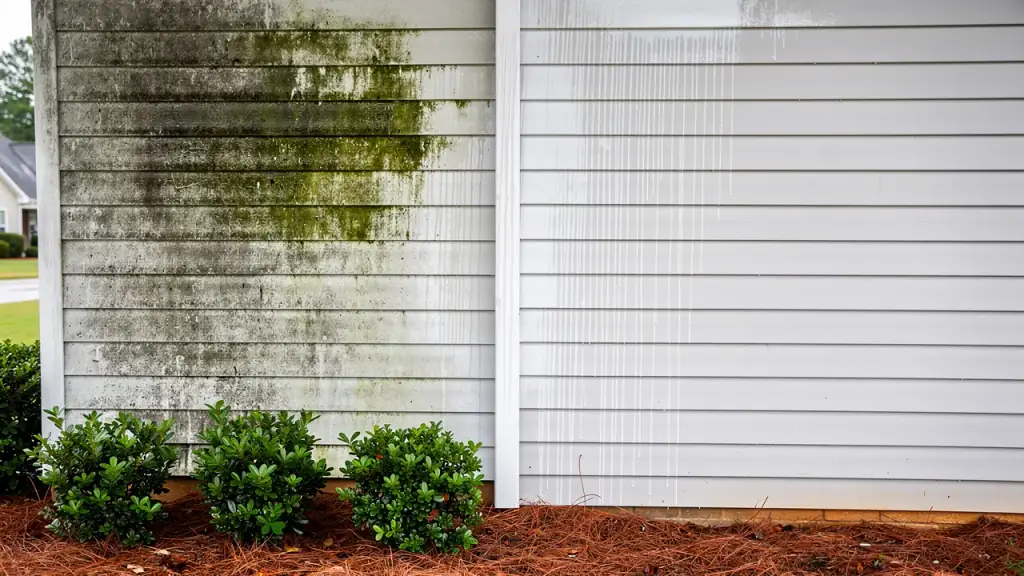
Walk around a neighborhood in Kennesaw or Smyrna in late summer and you'll see the same thing on a lot of houses: green fuzz low on the siding, black streaks running down from the gutters, a dull grey film across the north wall that wasn't there a few years ago. Most owners assume it's dirt that built up over time. It isn't, or at least not only. What you're looking at is alive, and that changes how it should be cleaned.
What the streaks actually are
The green is usually algae. The black and dark grey streaks are most often mildew or a similar dark growth that settles on a surface and feeds on whatever it finds there, including pollen, dust and the thin film of grime that collects on every exterior wall. Both spread through spores that ride the wind and land on every house on the street. They only take hold where conditions let them stay damp. That's why one wall can look fine while the wall around the corner looks like a swamp.
Vinyl siding doesn't feed these growths the way bare wood might, but it doesn't have to. The surface holds a layer of organic debris, and that's enough. Once a colony starts, it gets darker and thicker each season, and the streaks tend to follow the path water takes down the wall.
Why north Georgia grows it so well
Our part of the state hands mildew almost everything it wants. Summers are warm and humid, spring brings a heavy coat of yellow pine pollen that settles on every vertical surface, and plenty of lots around Cobb County are packed with tall pines and hardwoods that keep walls in shade for most of the day. Warmth, moisture and food in the same place is the whole recipe.
Add red clay to the picture. Clay soil splashes up from beds and downspout outlets during heavy rain and leaves an orange-brown band along the bottom of the siding. That band holds moisture against the wall and gives growth a head start right at ground level.
Why the shady wall goes first
Walk the whole house before you decide how bad it is. The north side, the side facing a neighbor's fence, and any wall behind a thick stand of shrubs stay damp longer after rain and after morning dew. Sun dries a wall quickly and does a lot of the work for you. Without it, the surface stays wet and the growth keeps going.
Look under the roof edge too. Where a gutter overflows or a downspout dumps next to the wall, you'll often see a dark vertical stripe. That spot never fully dries, and mildew loves it. If you find one, it's worth fixing the water problem as well as cleaning the stain, or the stripe will be back within a season or two.
What a garden hose and a scrub brush miss
Most people try the hose first. It knocks off loose dust and a little pollen, but it doesn't kill what's rooted in the surface, so the green comes back, often by the next summer. A stiff brush and a bucket of cleaner works better, but a two-story house means a lot of ladder time, and scrubbing hard on siding can leave marks of its own.
A proper house wash goes after the growth itself. Cleaning solution is applied to the wall, left to work for a few minutes, then rinsed off with controlled water. The idea is to break down the algae and mildew and let the rinse carry it away, not to blast the siding with force. That's the general approach across the trade, because siding, trim, window seals and the caulk around them don't take punishment well. Very high pressure aimed at the wrong angle can push water up behind the lap of the siding or leave streaks of its own.
What to check around your house
- Look at the north and shaded walls first, since they usually show the worst of it.
- Check the bottom two feet of siding for an orange-brown band of splashed clay.
- Follow each gutter and downspout down the wall and look for dark vertical stripes.
- Check the soffits and trim, where mildew likes to sit on painted surfaces.
- Note any plants close to the wall so you can point them out to whoever does the wash.
There's no fixed schedule that fits every house. A home in full sun on an open lot may stay presentable for years. A house tucked under pines in Woodstock or Roswell can start greening up within a season or two after a wash. The practical answer is to walk around the house each spring and again in the fall. If the streaks have come back or the shaded wall has a green tint you can wipe off with a finger, it's time.
Who does house washing in Marietta
House washing is one of the three services Soldiers Elite Pressure Cleaning offers, alongside pressure washing and deck cleaning and restoration. The company is owned by Army combat veteran Raymond Miley, who employs veterans and National Guard members, and it serves Marietta and ten other towns across the area, from Acworth and Cartersville to Sandy Springs and Rome.
If your siding has started to look green or streaked, you can call Ray at (678) 203-2912 or send a message through the contact page. Tell him which walls look worst and what grows beside them, and he can tell you what to expect.
Soldiers Elite Pressure Cleaning, (678) 203-2912
Call (678) 203-2912More articles
Red clay, pine tannin and mildew: what is really staining your driveway
That grey-brown mess on your concrete is usually several different stains stacked on top of each other.
Is your deck grey or just dirty? How to read weathered boards
Not every grey deck is worn out, and not every green one is only dirty, so look before you decide.