Is your deck grey or just dirty? How to read weathered boards
Not every grey deck is worn out, and not every green one is only dirty, so look before you decide.
October 20, 2026 · 4 min read
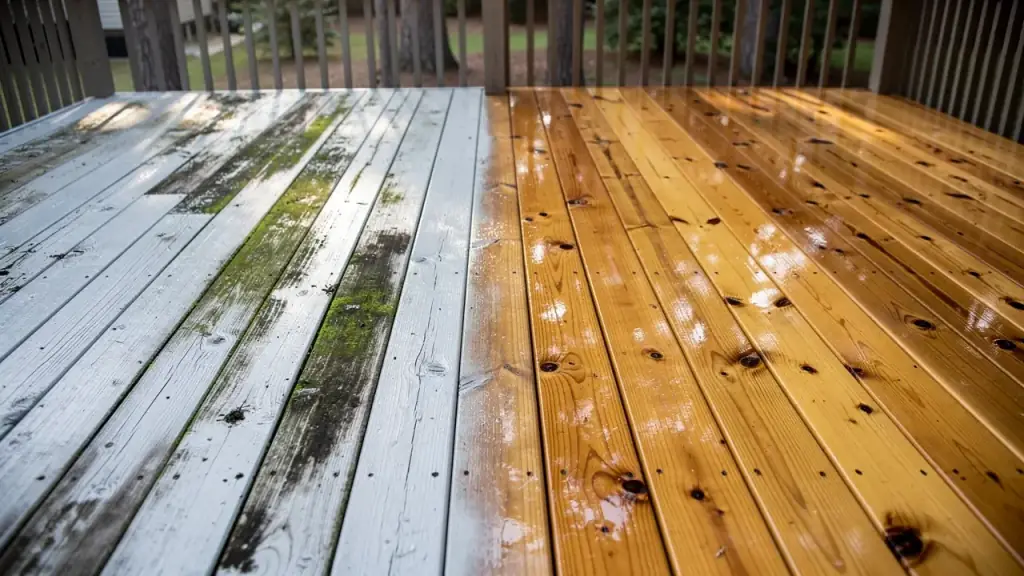
A wooden deck in north Georgia has a hard life. It bakes in July, soaks in every thunderstorm, collects pine needles all fall and sits in the shade of the house half the day. By year three or four, a lot of decks around Woodstock and Roswell have turned the same dull grey, and the owner has the same question: is this wood worn out, or is it just dirty?
The answer matters, because the two problems call for different fixes. Here's how to read what your boards are telling you.
Why wood turns grey in the first place
Fresh lumber has a warm color, honey or tan or reddish depending on the species. When it's left unsealed, sunlight starts breaking down the surface fibers within a season or so. Rain washes away the broken-down material and leaves a thin layer of grey, weathered wood fibers on top. That grey layer is real, but it's shallow. Underneath it, the wood is usually the same color it started.
This is why cleaning a grey deck can be so dramatic. Take the weathered surface layer and the grime off, and the original tone of the boards often shows through again. The grey isn't damage in most cases. It's a surface condition.
A few quick checks will sort most decks into one pile or the other.
Weathered boards are evenly silvery, almost like driftwood, and feel dry and slightly rough or fuzzy. The color is uniform across boards in full sun. Dirty boards are blotchy. You'll see dark patches under the planters and the grill, green or black growth where the shade falls, and a slick feel when the surface is damp. A deck can easily be both, and in Georgia it usually is.
The slick green layer is living growth
Algae and mildew grow on decks for the same reasons they grow on siding. Warmth, moisture and organic debris are all around. Shaded boards near the house wall, boards under a tree, and the first few feet of stair treads stay damp, and that's where you'll find the green film first.
This part is more than cosmetic. A wet deck covered in algae is slippery, and stairs are where people get hurt. If your boards feel greasy underfoot after rain, the surface needs cleaning regardless of how the color looks.
What goes wrong when cleaning is rushed
Wood is much softer than concrete, and that's the main trap. Pressure that's fine for a driveway can chew into a deck board, raising the grain into a fuzzy mess, leaving lighter stripes where the wand lingered, or scarring soft spots until they look like tiger stripes. Once the grain is torn, the board is rougher, holds dirt faster and often needs sanding to look right again.
The general rule across the trade is that the softer the surface, the more control and the less force you want. Wide passes, a consistent distance and moving with the grain give a far better result than power alone. If anyone offers to blast a decade of weathering off a cedar deck in ten minutes, that's worth a second thought.
Cleaning is one job, restoring is another
Cleaning removes the grey layer, the algae and the stains. Restoration is what happens next: letting the wood dry fully, looking over the boards for anything that needs attention, and talking about a protective finish. Unsealed wood will start to gray again, and a deck that's been cleaned and left bare is more exposed than one that was dirty, because the dirt was at least a thin layer of cover.
Drying time depends on the weather and how shaded the deck is. A deck in full sun on a dry week is ready sooner than one wedged under a roofline in a wet spell. Rushing a sealer onto damp boards is a common reason finishes peel or turn cloudy, so a patient schedule beats a fast one.
When it is not just surface
Some problems don't clean off. Press a screwdriver or key gently into the board and into the joists near the ground. Wood that's soft, crumbly or spongy has rot, and a wash won't fix it. Look for loose or rusted fasteners, wobbly railings and boards that have cupped or split along the edges. These need repair before or after the cleaning, and an honest contractor will point them out rather than polish over them.
- Run your hand across the boards: fuzzy and dry points to weathering, slick and damp points to algae.
- Check the shaded corner and the top step first, since growth shows up there earliest.
- Probe the boards and railing posts near the ground for soft spots.
- Note anything you want to protect, like climbing plants or railing planters, so it can be moved or covered.
- Decide whether you want a clean-only result or a sealed finish afterward.
Deck cleaning and restoration in Marietta
Deck Cleaning and Restoration is one of the three services Soldiers Elite Pressure Cleaning offers, along with pressure washing and house washing. Raymond Miley, an Army combat veteran, owns the company and employs veterans and National Guard members. The crew works across Marietta, Acworth, Kennesaw and the rest of the service area.
If you can't tell whether your deck is worn or just dirty, call Ray at (678) 203-2912 or send a note through the contact page and describe what you're seeing.
Soldiers Elite Pressure Cleaning, (678) 203-2912
Call (678) 203-2912More articles
Why siding in Marietta turns green and black, and what a house wash does about it
The streaks on your siding are alive, which is why a garden hose never gets rid of them for long.
Red clay, pine tannin and mildew: what is really staining your driveway
That grey-brown mess on your concrete is usually several different stains stacked on top of each other.