Red clay, pine tannin and mildew: what is really staining your driveway
That grey-brown mess on your concrete is usually several different stains stacked on top of each other.
October 20, 2026 · 4 min read
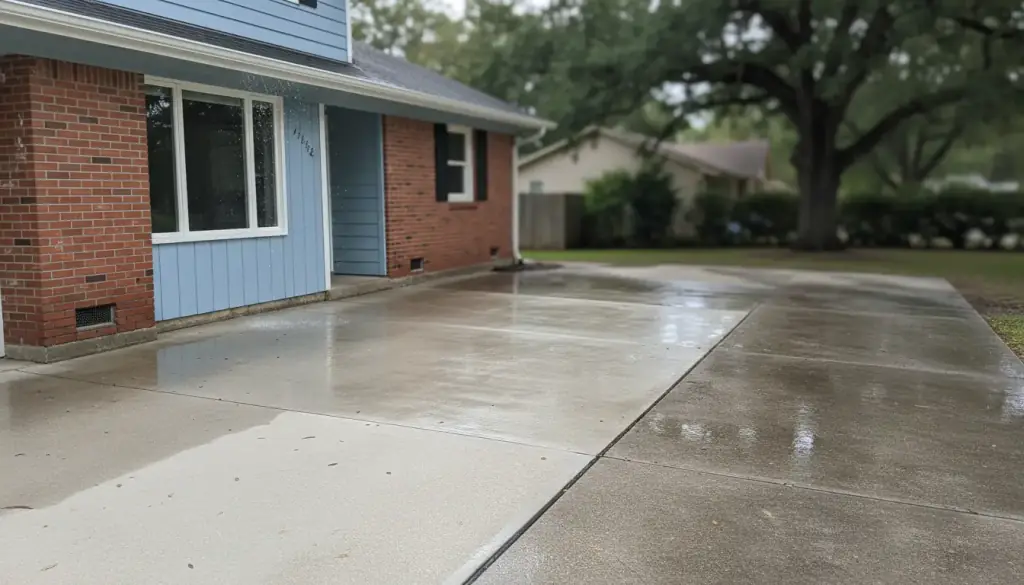
Look closely at a driveway in Powder Springs or Dallas after a few years and you rarely see one clean problem. You see an orange tint near the edges, brown blotches under the pine tree, black patches where the shade sits, a dark oval where the truck gets parked. Homeowners tend to lump it all together as dirt. Each of those marks has a different cause, and understanding them makes it easier to judge what a cleaning can do.
Concrete looks solid, but the surface is full of tiny pores. Rain, spilled liquid and leaf juice soak into them rather than sitting on top. Over a few seasons, the top layer of a driveway collects whatever lands on it and keeps it. That's also why a driveway that looks a little grey when dry can turn noticeably darker when it rains: the pores are full of material that wasn't washed out.
Red clay: the orange that won't leave
Around Marietta, the soil underneath most lawns is red clay, and it gets everywhere. It washes out of beds during storms, rides in on tires and shoes, and sprays up from mower wheels. The fine particles settle into the pores of concrete and leave an orange or rust-colored tint, especially along the edges where a lawn meets the slab and at the foot of any slope that drains toward the driveway.
Clay is mostly mineral, so it usually lifts better than people expect once the surface is properly cleaned. The tint that has been there for years can take more than one pass, and a driveway with a lot of staining may not come back to the color it was on day one.
Pine tannin: the brown shadow under the trees
North Georgia is full of pines and hardwoods, and everything that falls from them stains. Pine needles, bark, sweetgum balls and wet leaves release tannins, the same brown compounds that color a cup of tea. Left on a damp slab, they soak in and leave brown blotches that follow the outline of whatever sat there. You'll often see a faint pattern of needles or leaf shapes where debris stayed through a wet spell.
The best defense is dull but effective: sweep or blow the slab clear after storms and in the fall, and don't let wet debris sit for weeks. Once it's in the surface, it takes cleaning to get it out.
Mildew and the black patches in the shade
The black or dark green patches on a driveway are almost always mildew and algae, the same living growth that streaks siding. They favor the shady, damp stretches: beside a garage wall, under a big oak, along the low edge where water pools. A slab with this growth is slippery when wet, which is a safety issue on a sloped driveway as well as a cosmetic one.
Because it's alive and spreads, mildew keeps going until it's cleaned off. A driveway that was fine two summers ago can look dark in the shaded half now.
Oil, rust and tire marks
These are the stains with the most mixed results, so it helps to be realistic. Fresh oil is easier to deal with than oil that has soaked in for years. Rust from a metal planter, a bike or a grill leg leaves an orange mark that looks like clay but behaves differently. Tire marks, especially from a hot summer afternoon, can bond into the surface. A cleaning can lighten all of these. Whether any one of them disappears completely depends on how long it has been there and how deep it went.
What washing does and what it doesn't
Washing a driveway lifts the surface grime, the clay and the growth, and it often changes the look of the whole yard because the slab is such a large flat area. It's also the part of the job where too much force does harm. Concrete can be etched by a tip held too close, which leaves lighter lines or a striped finish. Control matters more than raw power, and even, overlapping passes matter more than speed.
Washing won't repair cracks, heal a spalled surface or change a slab that was poured with an uneven color. It also can't stop clay from coming back if the bed beside it keeps washing onto the concrete. A bit of mulch or edging along the problem spots goes a long way.
What to look for before you call
- Walk the driveway after a rain and note where water pools, since mildew follows the damp spots.
- Mark which stains are fresh and which have been there for years.
- Check where your downspouts and lawn drainage empty onto the slab.
- Move cars, bins, basketball hoops and planters so the whole surface is clear.
A clean driveway under tall pines stays clean for a shorter time than one in full sun. That's just the shade and the needles at work. Sweeping regularly, trimming back branches that hang over the slab, and fixing drainage that sends clay onto the concrete will all stretch the time between washes.
Pressure washing is one of the three services Soldiers Elite Pressure Cleaning provides, along with house washing and deck cleaning and restoration. Owner Raymond Miley, an Army combat veteran, runs the crew out of Marietta and serves driveways from Smyrna to Cartersville. If you want to talk about what's on yours, call Ray at (678) 203-2912 or reach out through the contact page.
Soldiers Elite Pressure Cleaning, (678) 203-2912
Call (678) 203-2912More articles
Why siding in Marietta turns green and black, and what a house wash does about it
The streaks on your siding are alive, which is why a garden hose never gets rid of them for long.
Is your deck grey or just dirty? How to read weathered boards
Not every grey deck is worn out, and not every green one is only dirty, so look before you decide.